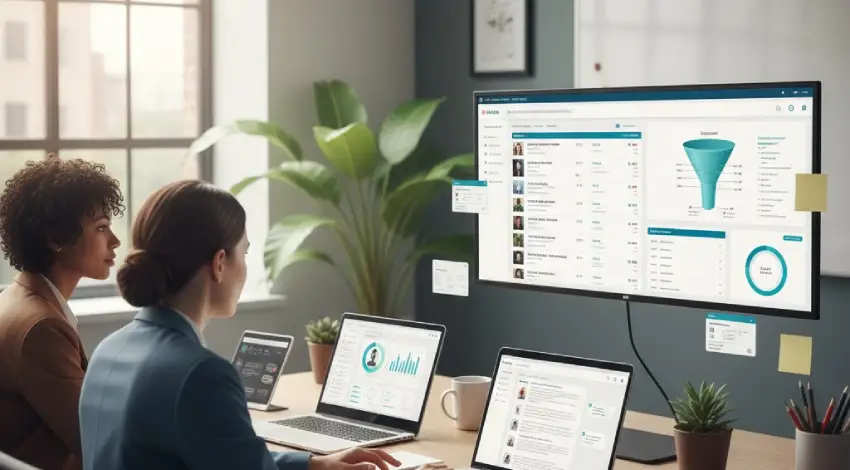
Picture this—one sales professional closes three deals in a single day without ever stepping out of the office, while another spends hours on the road to secure just one client meeting. Both approaches can be effective, but which sales model is the best fit for your business goals?
Nowadays, sales teams have to make a decision.
Should they focus on the efficiency of remote work or the building of relationships through face-to-face meetings?
This guide explains both models in detail, their pros and cons, thus helping you to pick the right strategy for faster revenue growth.
What is inside sales?
Inside sales refers to sales made at a distance without the need for a face-to-face meeting. The team deals with potential clients through phone calls, video conferences, emails, and social platforms. To put it simply, it is the same thing, but instead of going out to meet the client, you meet him in your office. The main focus of inside sales is digital communications; your reps can build a solid network and increase your company’s revenue through the use of technology rather than visiting potential clients. Big names like Salesforce and HubSpot have scaled to billion-dollar businesses, following this very blueprint.
An inside sales department concentrates on:
- Engaging potential customers through different online platforms
- Conducting online product demos
- Following up through automated workflows
- Building relationships through regular media contacts, Rewarding customers quicker through digital contracts and e-signature
This method enables your sales force to contact more potential customers within less time; you can still manage to cover various markets and time zones but the travel costs are saved.
What is outside sales?
Outside sales or field sales are mainly based on direct and personal in-person interactions; your reps move around clients’ offices, participate in trade shows and meet the clients face-to-face to build a relationship, which is the essence of this model. This model is most suited for complicated deals with a large amount that require the involvement of more than one person.
The field sales personnel are responsible for
The field sales activities include:
- Visiting customer sites for product demonstrations
- Trade shows and networking events
- In-person contract negotiation requires
- Building trust through regular physical meetings
The extra time and travel investment for the outside sale builds closer relationships with key accounts. Large enterprise software companies will often make use of field reps to close six-figure contracts that may require multiple stakeholders and presentations in detail.
Inside vs outside sales: The core differences
Both models have the same end goal, which is to close the deal but they differ significantly in terms of approach:
| Aspect | Inside sales | Outside sales |
| Work environment | Remote from the office or home | In the field, meeting clients |
| Communication | Phone, email, CRM, video | Face-to-face presentations |
| Sales cycle | Shorter, quicker | Longer, relationship-focused |
| Deal size | Smaller, higher volume | Fewer deals, higher value |
| Interaction style | Digital and data-driven | Personal and experience-based |
The difference between inside and outside sales is basically speed versus depth. The remote method employs volume and efficiency while the field method concentrates on personal connections and gaining trust.
Which approach fits your business?
The choice you make depends on three factors at most: product complexity, customer size and sales cycle duration.
Go for inside sales:
- You are able to demonstrate your product online fully and effectively.
- Your clients are small and medium-sized businesses.
- You want to grow fast but at the same time keep control of your expenses.
- Your sales cycle is between 30 and 90 days
Go for outside sales:
- Your product is such that it requires a hands-on demonstration.
- Your clients are enterprise accounts or Fortune 500 companies.
- Your deals are driven by trust and long-term relationships.
- The average value of your contracts is more than $50,000.
There are many successful firms that have combined these two tactics to their advantage. The inside sales representatives are tasked with lead qualification while the outside sales representatives are negotiation with the major accounts in the end.
Inside sales strategies that drive results
Remote selling is not the same as field sales in terms of required tactics, thus different sets of inside sales strategies ought to be in place to enhance the performance of your team:
- Centralize Your Sales Data track every interaction, email, and call in one place. Abstract One provides your team with real-time visibility into pipeline health and customer history-so reps spend less time searching and more time selling.
- Automate Repetitive Work set up email sequences for follow-ups. Use scheduling tools for meetings. Automate data entry and reminder notifications. This will free your team to focus on actual conversations with the prospects.
- Personalize Every Interaction selling remotely doesn’t mean being robotic. Research each prospect before reaching out. Reference their company news, challenges, or recent achievements. Tailored messages receive 3 times better response rates than generic outreach.
- Invest in Skills Development train your representatives to be on video, listen actively, and handle objections through screens. Being able to connect remotely requires different skills from when you were face-to-face with someone.
- Performance Metrics Tracking continuously track call-to-close ratios, email response rates, and deal velocity. Then use this data to find out what works and replicate that throughout your team.
The rise of hybrid selling
There is still a clear distinction between inside and outside sales, though the border is becoming less and less visible. Working together in a hybrid way, teams get the best from both worlds. A hybrid selling approach includes the following steps:
- Through digital channels, inside reps carry out lead generation, initial outreach, and qualification.
- Outside reps come in at key face-to-face meetings, product demos or contract negotiations with major accounts.
This mix provides the advantages of one without the disadvantages of the other in terms of both efficiency and quality. The model followed by most technology companies is this one, where the inside teams have hundreds of prospects under their care, whereas the field reps concentrate on the top 20% of the opportunities.
Abstract One is equally efficient for both models and therefore you can oversee remote and field teams with a single platform. Your entire organization is in sync regardless of whether the reps work from home offices or client boardrooms.
Conclusion
Knowing what inside sales is and how it is different from field sales will help you create a more efficient sales team. The remote selling model brings in speed and scalability while the field sales model is all about building deep relationships and landing major contracts. Your best way may be a combo of both models. What really matters is managing your process effectively, that is, tracking the interactions, measuring the results and being able to adapt quickly to what is working. Whether your team is selling remotely, in person, or through a hybrid model, winning is all about matching your strategy to the customer’s needs and following through on it consistently.
FAQs
- What is inside sales?
Inside sales basically means selling remotely via phone, email, and video without any in-person meetings. In this case, reps can close deals either from an office or from home but they have to use digital communication tools.
- How does inside sales differ from outside sales?
Inside sales are done remotely and the sales cycles are shorter with smaller deals. On the other hand, outside sales require field visits and involve longer relationship-building stages.
- Which model costs less to run?
Inside sales costs significantly less since it eliminates travel expenses, reduces office space needs, and allows reps to handle more prospects per day.